
Liverpool Face Generational Transition as Ngumoha Emerges and Salah Departs
Authored by pokerbetonlineaustralia.com, 15/04/2026
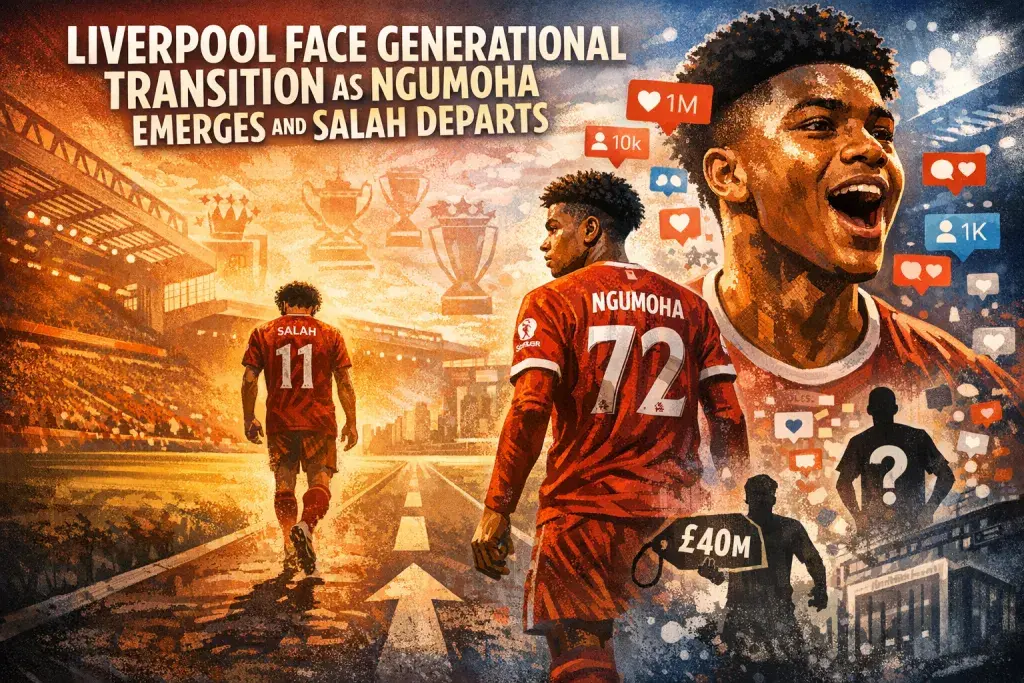
When Mohamed Salah walks out of Anfield for the final time this summer, he will leave behind one of the most decorated individual records English football has witnessed in a generation — 256 goals across 437 appearances, four Golden Boots, and three PFA Player of the Year awards accumulated over nine years. Into that vacuum steps a 17-year-old who has already broken the club's appearance records in two major competitions. The question now is not whether Rio Ngumoha has talent, but how Liverpool should manage it.
The Weight of Succession and Why Comparison Is a Trap
Former Liverpool forward Stan Collymore, speaking to GOAL in association with Best Betting Bonuses, offered a clear warning against the instinct to frame Ngumoha as Salah's natural successor. "I think that Liverpool have got to be very careful of pitching him like that because he's 17," Collymore said. His concern is rooted in something structural rather than sentimental: the media environment that surrounds young talent now is categorically different from the one that shaped previous Liverpool academy products.
Collymore drew comparisons to Robbie Fowler, Michael Owen, Steven Gerrard, and Jamie Carragher — all of whom were thrust into first-team football at similar ages during an era when exposure was limited and expectation, while real, was not algorithmically amplified. "Social media and a million football accounts," he argued, means that a single notable performance can generate a narrative of destiny that no 17-year-old is psychologically equipped to carry. The parallel he drew with Arsenal's Max Dowman — whose recent goal was treated, he suggested, as the defining moment of a season — illustrates the distorting effect of scale. Attention accelerates pressure. Pressure compresses development.
This is not a trivial concern. Sports psychology research consistently identifies premature public expectation as a factor in developmental stagnation among young elite performers. Ngumoha has made 23 appearances this season and registered two senior goals — a meaningful contribution, but one that still belongs to the category of promise rather than established output.
What Liverpool Are Likely to Do in the Transfer Market
Collymore's assessment of the club's likely approach to recruitment is instructive. Rather than pursuing a marquee like-for-like replacement — a move that would implicitly burden Ngumoha even further by defining him in opposition to whoever arrives — he suggested Liverpool would be more likely to invest modestly in a functional right-sided forward whose purpose is simply to do a competent job, not to inherit a legacy.
The historical analogy he reached for was Brian Clough's Nottingham Forest and the appointment of Frank Clark as his successor. Clark's effectiveness, Collymore argued, derived precisely from his refusal to position himself as Clough's equal. He inherited good personnel and made small, deliberate adjustments. The lesson for Liverpool: buy adequately, do not overpromise, and let the longer-term solution develop without artificial urgency. A figure in the range of thirty to forty million pounds for a reliable wide forward, combined with patience around Ngumoha, would allow the club to pursue both objectives simultaneously.
The Case for a Loan Move — and Why It Matters
Collymore was direct about one scenario that Liverpool may well consider: sending Ngumoha out on loan for the 2026-27 season. His preferred destination was revealing. "I think he's much better than a Championship loan," he said, indicating that the thinking is not about reducing exposure but about calibrating it. A Premier League club operating in a lower-pressure environment — Bournemouth was his specific suggestion — would offer regular first-team involvement against top-level opposition, within a well-structured setup, without the weight of a title contender's expectations.
Bournemouth, currently performing well under a settled coaching structure, represents exactly that kind of environment. It is a club where a young wide forward can accumulate meaningful minutes, develop physical robustness, and refine positional understanding without the scrutiny that attaches to every appearance in a high-profile squad. Crystal Palace, also mentioned by Collymore, offers similar characteristics — a Premier League club with genuine tactical identity and a record of integrating young talent with care.
Loan arrangements of this kind have become an increasingly deliberate part of elite club development strategies across Europe. The logic is simple: controlled exposure in a genuinely competitive setting accelerates the physical and cognitive adaptations that training alone cannot replicate. A full season of consistent involvement, away from the specific pressures of Anfield, could return Ngumoha to Liverpool in the summer of 2027 as a materially different proposition.
Ngumoha's Current Standing and What Comes Next
Ngumoha joined Liverpool from Chelsea in 2024 and signed his first professional contract in September 2025, by which point he had already become the youngest player to represent the club in both FA Cup and Champions League competition. In Liverpool's most recent Premier League fixture against Fulham — a 2-0 result — he and Salah started on opposite flanks and both contributed goals, with Ngumoha recording his first at Anfield.
That image — the departing legend and the emerging successor sharing a pitch and a scoresheet — is symbolically compelling. But Collymore's broader argument is that symbols are precisely what Liverpool should resist. The club's task this summer is to separate two distinct problems: finding a functional replacement for one of the Premier League's greatest-ever individual performers, and managing the long-term development of a teenager who may, in time, become something significant in his own right. Conflating those problems, he suggests, serves neither goal.
Liverpool have navigated this kind of transition before. The institutional knowledge is there. The question is whether the noise around Ngumoha — now louder and more constant than anything previous young players at the club have faced — allows the club to exercise the same quiet judgement.